

Leather production is one of humanity’s oldest crafts, dating back thousands of years. As early as the fifth millennium BC, the Sumerians were creating garments from cured animal skins, while ancient Egyptians produced leather gloves and the Phoenicians even used leather to make water pipes. Today, most leather is a by-product of the meat industry, with cowhide being the most common source due to its availability, size, and durability. Leather is also produced from animals such as pigs, sheep, deer, horses, and kangaroos. In addition, more exotic varieties come from animals like ostriches, alligators, snakes, frogs, and various species of fish.
Full Grain Leather
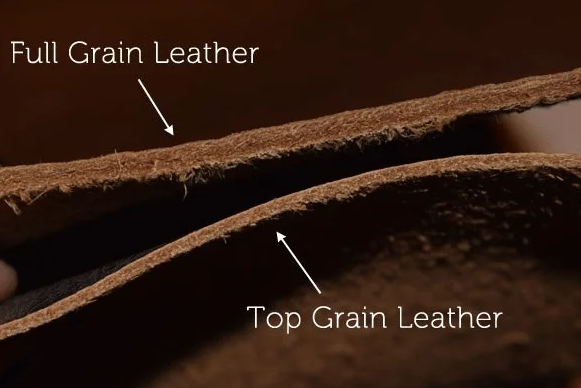
Full-grain leather comes from the very top layer of the hide and is treated with aniline dyes that penetrate the leather without obscuring its natural surface. In some cases, a semi-aniline dye is used, adding a light protective finish that helps resist staining while preserving the leather’s character. The dense, vertical fiber structure of this layer makes it the strongest and most durable part of the hide—it won’t crack, peel, tear, or easily puncture. Its tight grain also offers natural resistance to moisture.
What truly sets full-grain leather apart is its authenticity. Every hide retains its natural markings and variations, telling the story of the animal’s life—subtle scars, insect bites, wrinkles, and other unique details are all preserved. Over time, full-grain leather doesn’t wear out; it wears in. With use and age, it develops a deep, rich patina that enhances its beauty year after year. This ability to age gracefully is unique to full-grain leather, making it the finest leather available and the reason it’s the primary material used by MAHI in most of our products.
Top Grain Leather
Somewhat confusingly, top-grain leather does not come from the very top layer of the hide, but from the layer just beneath it. To create its smooth, consistent surface, the leather is sanded and buffed to remove natural markings and imperfections. While this process results in a more uniform appearance, it also reduces the leather’s overall strength and durability compared to full-grain leather, causing it to wear and deteriorate more quickly.
Top-grain leather is widely used in the production of quality goods because it is thinner, more flexible, and more affordable than full-grain leather, making it easier to work with. A common variation of top-grain leather is corrected leather, which undergoes additional sanding, buffing, stamping, and dyeing to achieve a highly uniform look. In this process, all natural characteristics of the hide are removed, resulting in a consistent finish at the expense of the leather’s natural texture and aging potential.
Nubuck and Suede Leather
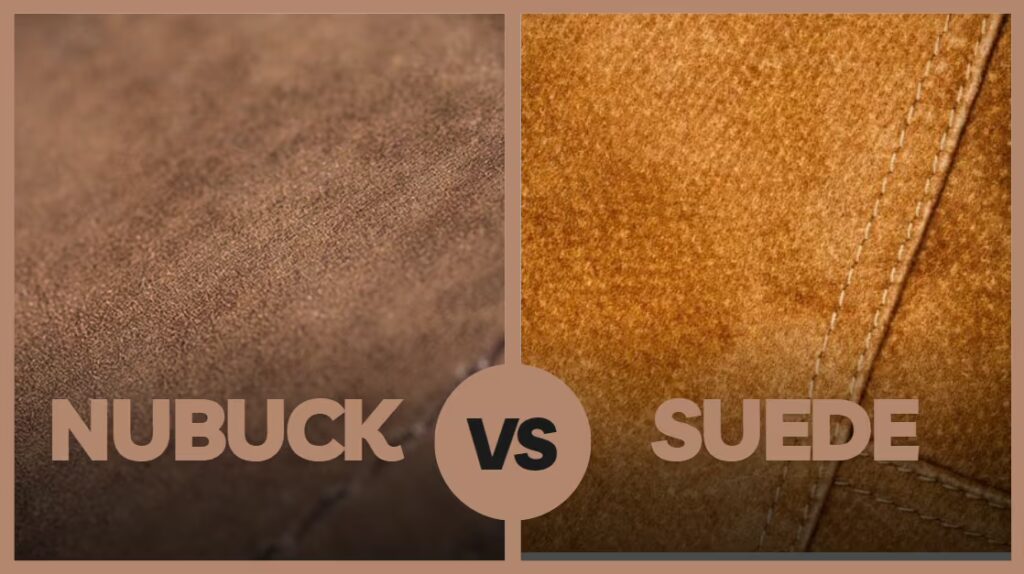
Originally crafted from deer or elk hide, nubuck gained popularity in the 1930s after the Duke of Windsor’s influential visit to America. Nubuck is a form of top-grain leather that has not been heavily processed; instead, its surface is lightly brushed and polished, raising the short protein fibers to create a soft, velvety finish.
Often compared to suede but considered more premium, nubuck has a rich surface that subtly changes shade when touched. It is thicker and more durable than suede, can be left natural or dyed in a range of colors, and has a slightly rougher appearance. Unlike suede, nubuck may still retain some of the hide’s natural markings, adding to its character and authenticity.
Suede is produced from the inner layer of the hide—the side that was originally in contact with the animal’s flesh. This surface is sanded and buffed to create a soft, velvety texture that is more flexible and supple than nubuck, though significantly less durable. Because suede is highly absorbent, it is also more prone to staining and moisture damage. We use this leather selectively, including in some of our leather jackets, where its softness and comfort are especially valued.
Faux or Synthetic Leather
Synthetic leather is a by-product of the chemical industry and has been produced since the 1940s. Sold under many brand names, it generally falls into two main categories: polyurethane (PU) and polyvinyl chloride (PVC), often referred to as vinyl.
Vinyl became a popular low-cost alternative for applications such as car interiors and utilitarian furniture found in hospitals or budget restaurants. While durable and easy to clean, vinyl tends to feel sticky and uncomfortable when in prolonged contact with human skin. Polyurethane, by contrast, is softer, more flexible, and somewhat more breathable. It can be printed to closely resemble the look of real leather, although it feels noticeably different to the touch. PU is more expensive than vinyl but still significantly cheaper than genuine leather.
More recently, advanced synthetic leathers have been developed to mimic the chemical structure of real leather, with claims of superior strength and durability. However, these materials are costly to produce and raise serious environmental concerns. They rely on petrochemicals that are non-renewable and non-biodegradable, and there is growing evidence that the microfibers released from synthetic materials—often shed during washing—are entering waterways and the food chain, posing long-term ecological risks.